A session to present and explain a concept map of current ELT. The idea is to show how the different ideas and acronyms relate to one another, so that we can keep the big picture in mind. We need to see both the wood and the trees! See a related article here.
Pronunciation is not only about the mouth, but also the ears. And, with English being a global language, the ears must learn to be flexible in order to make sense of all those varieties of spoken English out there. This session is about helping learners to deal with this variety.
Are your students inspired by your lessons or has their interest expired!? What can you do to attract their attention and generate intrinsic motivation? Are there any strategies you can use or is it just a question of inspiration? These are some of the questions we will address in this session.
In the first part of the talk, we will see how motivation leads to attention which in turn leads to learning. We will look at the difference between intrinsic and extrinsic motivation, and how the first leads to a better quality of attention. We will then look at strategies for creating intrinsic motivation in the classroom.
Pronunciation is not only about the mouth, but also the ears. And, with English being a global language, the ears must learn to be flexible in order to make sense of all those varieties of spoken English out there. This session is about helping learners to deal with this variety.
Pronunciation is just as important for listening as for speaking. In this workshop, we looked at how to help learners to understand authentic English by focusing on pronunciation. Specifically, we looked at features of connected speech and accent. You can download the slides and handout for the talk below.
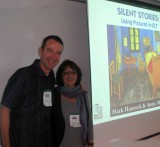
Pictures are like silent stories. Silent because they are non-verbal. Stories, because they are pregnant with content to talk about. For these two reasons alone, they are extremely useful in English language teaching. In this talk, we explain these and more advantages of pictures, as well as demonstrating different activity types for use in the classroom.
In this workshop, we present a syllabus of 8 features of English pronunciation of relevance for Brazlian learners. Each of the 8 points are explained and illustrated with a pronunciation game. You can download the handout and the slide show for the talk below. The full instructions for most of the games can be found in the materials section of this site.
There is a video of this lecture recorded at TESOL Spain, Bilbao below. Pronunciation is just as important for listening as for speaking. In this workshop, we will see how to help learners to understand authentic English by focusing on pronunciation. Specifically, we will look at features of connected speech, intonation, and accent.
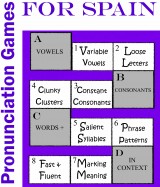
We will look at 8 features of pronunciation which are of particular relevance for Spanish speaking learners of English. These will include vowels, spelling of vowels, consonants, clusters, word stress, stress patterns, tonic syllables and joined up speech. Each feature will be explained, contrasted with Spanish and demonstrated with an example game.