I got my first teaching job in 1984, working at a large boy's secondary school in El Obeid, Sudan. This experience made it very clear to me that there's a lot more to teaching English than just being able to speak the language!
A conference truly focused on the pressing current concerns of local teachers, particularly the implementation of CLIL/bilingual programmes in schools.
María, who is a professor at the University of Alicante, began by asking the participants whether they had had explicit instruction in genre during their schooling. The answer for everybody was no. At school, we tend to have experience only of essay writing, with no awareness that there are many different genres of text, nor of how context and purpose shape the structure of these.
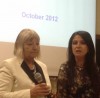
(Photo: Greta president Charo Reyes - right - introduces Diana Hicks) Diana began her thought-provoking session with the observation that, although education involves preparing people for the future, many pronouncements on the topic of education are dressed in nostalgic references to golden times past – phrases like “Back to Basics”, a reference to a British programme of putting more e
Victor began by projecting articles from the press highlighting the benefits of multilingualism. Articles quoting research showing that bilinguals are smarter, for example. He pointed out that the benefits can be classified into two kinds: a. social advantages, b. cognitive advantages. Victor went on to list 8 types/models of bilingual education, one of which was called “Transitional”.
This was very much a participative workshop session, based on classroom research material being developed by Mª Jesús. We began with group discussions on the importance of vocabulary and the most effective methods of learning it. Suggestions included relevance and motivation, repeated exposure, visual support, richness of context and test washback.
We looked at 8 features of pronunciation which are of particular relevance for Spanish speaking learners of English. These included vowels, spelling of vowels, consonants, consonant clusters, word stress, phrase stress patterns, tonic syllables and connected speech. Each feature was explained, contrasted with Spanish and demonstrated with an example game.
Éva Illés of ELTE in Budapest, began by explaining how English as a Lingua Franca (ELF) differs from pidgin: 1. Pidgin is limited, for example to one trade hub, while ELF is global; 2. Pidgin is limited to a trading domain, while ELF is used in all domains, and 3. Pidgin doesn’t have native speakers while ELF does.