Mark Hancock

All content by Mark is listed below:

Mark Hancock

Mark Hancock - hancockmcdonald.com/node/2/edit

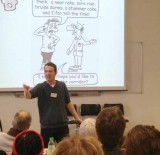
I got my first teaching job in 1984, working at a large boy's secondary school in El Obeid, Sudan. This experience made it very clear to me that there's a lot more to teaching English than just being able to speak the language!

Pronunciation as a Listening Skill

Speaker: 
Event date: 
Saturday, November 9, 2013 - 10:15
Venue: 
English UK
Location: 
London
Extra info: 
Plus downloads
Pronunciation - hancockmcdonald.com/focus/pronunciation

Pronunciation is just as important for listening as for speaking. In this workshop, we will look at what features make connected speech difficult to follow. We will try out a series of tasks and games for raising awareness of these features. Finally, I will suggest how teachers can prepare their own micro-listening activities.

A Map of Motivation at NILE

Speaker: 
Event date: 
Wednesday, August 7, 2013 - 14:00
Venue: 
NILE
Location: 
Norwich, UK
Extra info: 
Includes handouts
Talks - hancockmcdonald.com/talks

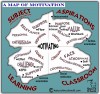
There's more than one way to motivate. In this talk, we take a tour of the Map of Motivation, from aspirations through subject matter, classroom conditions and effective learning. The main slides from the talk and the handout can be found below. There's also a ten minute video tour of the map.

A Map of Motivation video

Posted by: 
Blog - hancockmcdonald.com/blog/145

Take a trip round the Map of Motivation. This is a tour designed specifically for English language teachers who find the whole conceptual area of motivation a bit diverse and difficult to hold in your head all at once. Just click on the movie below, and please give us any feedback that occurs to you, ideas for improvement and so on!

5 Pronunciation Games for Brazil

Posted by: 
Publication: 
New Routes (DISAL), May 2013
Pronunciation - hancockmcdonald.com/focus/pronunciation

This is an article which featured in the online magazine New Routes.

Adrian Underhill on pronunciation as the Cinderella of ELT

Posted by: 
Conference-Reports - hancockmcdonald.com/taxonomy/term/140/feed
Adrian began by pointing out how central pronunciation is to language learning. And while this is obviously true for spoken production, it is also true, surprisingly enough, for reading, writing, or even thinking in the target language. For example, during reading, we tend to sub-vocalize, that is, hear the words aloud in our heads. And how will these words be pronounced in our heads?

Pronunciation as a Listening Skill at NATESOL

Speaker: 
Event date: 
Saturday, May 18, 2013 - 11:45
Venue: 
Salford City College
Location: 
Worsley, Greater Manchester
Extra info: 
Includes handouts
Talks - hancockmcdonald.com/talks

Pronunciation is just as important for listening as for speaking. In this workshop, we will look at what features make connected speech difficult to follow. We will try out a series of tasks and games for raising awareness of these features. Finally, I will suggest how teachers can prepare their own micro-listening activities. Find PDF of handout below...

A Chat about Pronunciation, ELF and listening

Posted by: 
 - hancockmcdonald.com/ideas.xml/67

Mark Hancock, in an interview with Andi White for IATEFL Online, talks about English as a Lingua Franca and about pronunciation as a listening skill. Read the transcript on the PDF below. Listen to the talk about pronunciation for listening here.

Pron 4 Spain

Speaker: 
Event date: 
Friday, April 19, 2013 - 11:00
Venue: 
EOI Orihuela
Location: 
Murcia
Extra info: 
Includes handouts
Talks - hancockmcdonald.com/talks

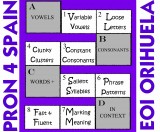
We will look at 8 features of pronunciation which are of particular relevance for Spanish speaking learners of English. These will include vowels, spelling of vowels, consonants, clusters, word stress, stress patterns, tonic syllables and joined up speech. Each feature will be explained, contrasted with Spanish and demonstrated with an example game.

Rachel Roberts on doing Dogme WITH a coursebook

Posted by: 
IATEFL-Liverpool - hancockmcdonald.com/taxonomy/term/159/feed

Rachel’s was one of several talks at this year’s IATEFL which sought to redress the balance in the coursebooks versus Dogme dichotomy. Others included Hugh Dellar and Herbert Puchta. Her principle claim is that you don’t have to choose between using a coursebook or letting the language ‘emerge’ from interaction in the classroom – you can do both.

Pages

Subscribe to RSS - Mark Hancock