I got my first teaching job in 1984, working at a large boy's secondary school in El Obeid, Sudan. This experience made it very clear to me that there's a lot more to teaching English than just being able to speak the language!
There's so much more to teaching pronunciation than drilling and the phonetic alphabet. A few simple exercises can open your students' senses to the rhythms and patterns of speech.
Imagine this. You're moving into a brand new flat. Everything is empty, just waiting for you to inhabit it in the way you please. Everything functions perfectly, from the plumbing to the electricity, from the gas to the phone line.
If you want your students to be able to say ‘I can speak English’, they need speaking practice in class. But this often turns out to be difficult and messy, and many teachers avoid it. In this workshop, we will classify the practical problems of speaking practice activities into three kinds, relating to:
IATEFL Pronunciation Sig magazine 'Speak Out', issue 30, Sept 2003
For me, the first example that springs to mind when talking about minimal pairs is ship or sheep. This is almost certainly due to the influence of the title of the well known book Ship or Sheep by Anne Baker. The formula is this: take a word, remove one of the phonemes and replace it with another such that it forms a different word.
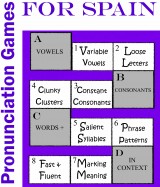
We will look at 8 features of pronunciation which are of particular relevance for Spanish speaking learners of English. These will include vowels, spelling of vowels, consonants, clusters, word stress, stress patterns, tonic syllables and joined up speech. Each feature will be explained, contrasted with Spanish and demonstrated with an example game.
Songs have long been popular with language teachers. They demonstrate language in a memorable, motivating way. However, all too often, the exploitation is limited to gap filling. In this workshop, we will look at other ways in which they can be used in the classroom.
Too often, we treat writing as mere grammar practice. But writing is communication too. In this workshop, we will look at classroom tasks which focus on meaning and content in writing, and not just form. Lot’s of imaginative and creative ideas to take away!
In this talk I will highlight some patterns in English language classroom talk. I will suggest how these patterns arise, and what their implications are for language learning. I will conclude that it may be better not to talk like a teacher sometimes.
(I have also presented this talk at TEA (Canary Islands) and as a plenary at CETA (Cordoba, Spain))
English Teaching Professional, issue 40, September 2005
There are three distinct aspects of intonation:
1. Separating what you say into groups of words;
2. Stressing the most important word in each of these groups;
3. Ending each group of words with the voice going up or down.
In this article, we’ll look at simple, practical ways of presenting intonation from each of these three ‘takes’ in turn.
This article examines the code switching that goes on during group work in language classes in which the learners share an L1. The author argues that the discourse produced in these circumstances is layered as a result of the participants' oscillating between a literal and a nonliteral frame (Goffman, 1974).